Summary
Research Interest
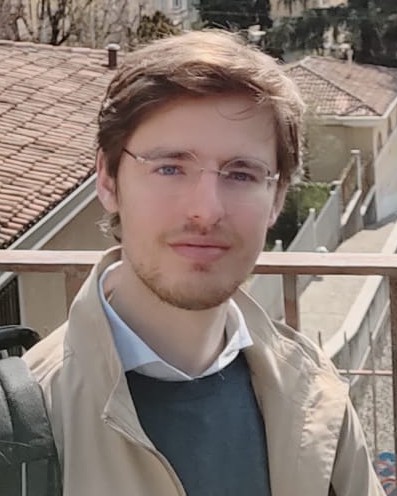
Miguel Molinos is a recent Ph.D. graduate in Computational Mechanics. His main line of research during his PhD was the mathematical and numerical modelling of the inelastic behaviour of structures, geostructures, and engineering materials (soils, concrete, steel, and rubber-like substances) using mesh-free techniques. Right now he is working on the development of multiscale models with atomistic resolution.
Short Biography
He received his (4 years) B.Eng. degree in Civil Engineering from the Universidad de Sevilla, awarding an honours grade for his bachelor’s thesis in tsunami simulation. As an undergraduate student he did a part-time internship in Drops and Bubbles Technology, a spin- off of the Department of Aerospace Engineering and Fluid Mechanics of the University of Seville where he worked in the simulation of bi-phasic flows with the commercial Computational Fluid Dynamics (CFD) software ANSYS-Fluent. In September 2016 he moved to Madrid to continue his studies in the School of Civil Engineering of the Universidad Politécnica de Madrid (UPM).
In 2018 he obtained his (2 years) M.Eng. degree in Civil Engineering finishing in the first decile of his promotion. Simultaneously, during a part-time internship in the Centre for Hydrographic Studies (CEDEX, Spanish Public Administration), he contributed to the implementation of a multi-thread GPU solver for Iber2D (CFD software). This internship provided him with important experience on practical engineering problems in a Technical Laboratory which is a reference centre of Spain in its domain. This practical experience complements well his solid theoretical background.
In September 2018 he started his predoctoral research career in the Computational Mechanics field in the Applied Mathematics Department of the Civil Engineering School of the UPM with the M2i group led by Professor Manuel Pastor. After the first period of training where he took courses to improve his programming skills (Introduction to R, Python for Engineers, and Programming in the GPU with CUDA), he started the implementation from scratch of an open- source code for mesh-free simulations (NL-PartSol, C). His research has been focused on the proposal, development and assessment of the Local maximum-entropy Material Point Method (LME-MPM) for dynamic, fracture mechanics, finite strains, and poromechanics problems. His contributions to the M2i group have been relevant. Indeed, he has overseen opening a new research line, modelling materials with complex behaviour using the LME-MPM method, instead of the classical SPH approach used so far. His research was financed between 2018 and 2020 by the Agustín de Betancourt foundation and in 2021 by the José Entrecanales Ibarra foundation. In December of 2021, he defended his thesis entitled “The Local Maximum-Entropy Material Point Method” obtaining the qualification of cum laude and in September 2022 he was awarded with the Ioannis Vardoulakis PhD prize.
From 2022 to 2024 he held a Juan de la Cierva postdoctoral fellowship at the Universidad de Sevilla, working with Professor Pilar Ariza on multiscale atomistic models. He is currently at the Universidad Politécnica de Madrid (UPM), where he continues his research in computational mechanics and multiscale modelling.